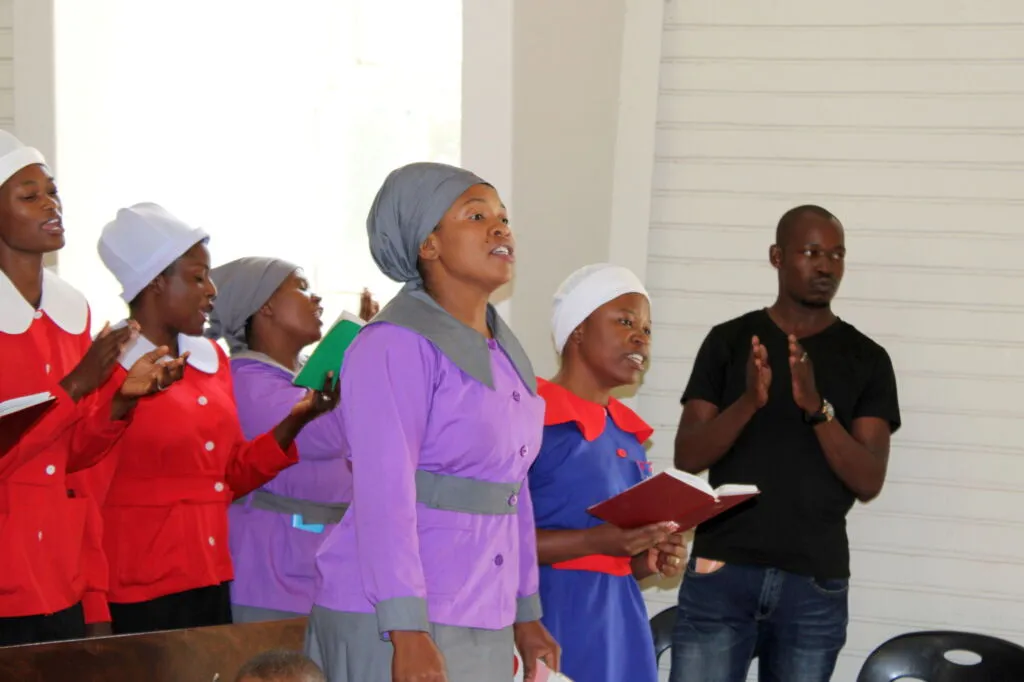
The United Theological College is an ecumenical institution founded and owned by six member churches. United in faith and diverse in tradition, they represent Wesleyan, Lutheran, Reformed and Congregational streams, bound together by a common commitment to prepare men and women for faithful service and authentic development in ways that promote the well-being of God’s people.
Methodist Church in Zimbabwe (MCZ)
MCZ is a founding member church of the United Theological College (formerly Epworth Theological College) and belongs to the Wesleyan tradition tracing its spiritual heritage to John and Charles Wesley. Methodism arrived in Zimbabwe on 29 September 1891 when Rev. Owen Watkins and Rev. Isaac Shimmin, accompanied by African evangelists including Joseph Ramushu, Modumedi Moleli, Samuel Tutani and Wellington Belisi, were sent from the Transvaal to Mashonaland. They planted the first mission stations at Fort Salisbury (Harare), Epworth, Nenguo and Kwenda, later extended to Tegwani in Matabeleland in 1897, Sandringham in 1913, Chemhanza and Pakame. For over seven decades the church was led by missionaries until Rev. Andrew Majoni Ndhlela became the first black General Superintendent, and in 1977 the church attained autonomy with Rev. Ndhlela as its first President.
Today MCZ is led by the Presiding Bishop, headquartered in Harare and organised into eight Districts – Bulawayo, Hwange, Gweru, Masvingo, Kadoma, Marondera, Harare East and Harare West. It has over 123,000 members in Zimbabwe and a growing diaspora of over 2,700 members across Botswana, South Africa, UK, USA, Canada and Australia. Its identity is shaped by its strong spiritual movements – Ruwadzano/Manyano Women’s Movement, Men’s Christian Union, Girls’ and Boys’ Christian Union, Methodist Young Disciples and Sunday School. Its holistic mission is lived out through education with 20 primary and 9 secondary schools including Waddilove, Sandringham and Tegwani, through health services, through the care of vulnerable children at Matthew Rusike Children’s Home, and through community development, agriculture and social justice advocacy through its development arm, the Methodist Development Relief Agency (MEDRA).
United Methodist Church in Zimbabwe (UMCZ)
UMCZ is a member church of the College and part of the global United Methodist family. Its story began in 1898 at Old Mutare when Bishop Joseph Crane Hartzell of the American Methodist Episcopal Church established a mission that would become the gateway for American Methodism in the country. From those early stations at Old Mutare, Mutambara and Murewa, the church grew rapidly among both settlers and indigenous communities. Today it is part of the Zimbabwe Episcopal Area, led by a Resident Bishop and organised into two vibrant Annual Conferences, Zimbabwe East and Zimbabwe West, with numerous districts, circuits and thousands of local societies. It is one of the largest Protestant denominations in the nation.
The UMCZ is widely known for its transformative approach to mission. It is the founder and sponsor of Africa University in Mutare, the first United Methodist-related university on the continent, which has become a centre of academic excellence for Africa. It also runs a vast network of primary and secondary schools and owns three of the most respected mission hospitals in the country at Old Mutare, Mutambara and Nyadire, alongside numerous clinics. Its ministries include evangelism, higher education, health, HIV and AIDS response, orphan care, women’s and youth empowerment and environmental stewardship, all rooted in Wesleyan holiness and social holiness.
Evangelical Lutheran Church in Zimbabwe (ELCZ)
ELCZ is a member church of UTC, the Lutheran World Federation and the World Council of Churches. It was founded in 1903 by missionaries of the Church of Sweden Mission and African evangelists from the Lutheran Church in Natal, South Africa. Swedish missionaries Pastors Liljenstrand and Hellden were sent to then Southern Rhodesia and began work mainly in the Mberengwa district. From the beginning the church embraced Christ’s three-fold ministry of preaching, teaching and healing – first enabling converts to read the Bible through schools, then adding medical work in 1915.
The first trained African pastor was ordained in 1937, and in 1962 the church became autonomous from Sweden and Natal, with the last Swedish missionary bishop, Sigfrid Strandvik, retiring in 1975 to be succeeded by Zimbabwean Bishop J.C. Shiri. Its foundation of faith is the Word of God in the Old and New Testaments, the Apostles’, Nicene and Athanasian Creeds, and the pure Lutheran Doctrine as contained in Luther’s Small Catechism and the Augsburg Confession. Led by a Presiding Bishop with headquarters in Bulawayo, it is organised into three Dioceses – Eastern, Central and Western – covering all ten provinces. With about 300,000 members, 396 congregations and 68 pastors, its life is nourished by its five organs: Witnesses, Women’s Union, Luther League, Youth and Sunday School. Its commitment to diakonia is expressed through 13 schools, two Bible Schools, a women’s centre, four hospitals, and extensive community programmes in malaria prevention, HIV, gender justice and food security through Lutheran Development Service (LDS).
United Church of Christ in Zimbabwe (UCCZ)
UCCZ is a Reformed-Congregational member church with deep American Board roots. Established by the American Board of Commissioners for Foreign Missions in 1893, the gospel was first preached at Mount Selinda in Chipinge, where the first congregation was gathered in 1897, with the iconic Mount Selinda church building completed in 1919, and almost simultaneously at Chikore. A key early priority was the translation of the Bible into Ndau, a work that began in 1908 and continued despite the loss of the printing press in a fire in 1915. The church was administered by the American Board until 1971, when local leadership took over under Rev. E. J. Mwadira and later Rev. Dr. W. M. Mkwakwami, becoming the United Church of Christ in Zimbabwe in 1981. It is governed by a Synod led by a President and, since 2023, is organised into five Conferences: North Eastern, Highlands, Urban North, Urban West and Western. It has over 100 local churches and preaching points with about 30,000 active members and a wider community of 300,000, two-thirds of whom are women.
Living out its motto “That they all may be one” (John 17:21), the UCCZ is strongly ecumenical and justice-oriented. Its spiritual councils – Junior Sunday School, Christian Youth Fellowship, Ruwadzano Women’s Union, Volunteers and Christian Men’s Fellowship – animate its worship and witness. Its holistic ministry is visible in its 20 primary and secondary schools, its two tertiary institutions including a teachers’ college and the renowned agriculture college at Mount Selinda, its four health facilities including Mount Selinda Hospital, and its long history of sustainable farming, water development and food security programmes that have supported communities in the Eastern Highlands and the Lowveld since the early 1900s.
United Congregational Church of Southern Africa (UCCSA) – Zimbabwe Synod
UCCSA is a transnational, prophetic and justice-seeking Church. The UCCSA was born on 3 October 1967 when three Congregational streams – the London Missionary Society (LMS) formed in 1795; the Bantu Congregational Church, linked to the American Board Mission; and the Congregational Union of South Africa – covenanted to become One Church. The LMS had already been present in what is now Zimbabwe for 108 years. The Zimbabwe Synod itself was formally constituted in 1978 and is one of five Synods alongside Botswana, Mozambique, Namibia and South Africa, making the UCCSA One Church in Five Countries. While the union is recent, its roots go back almost 200 years to the first LMS personnel in Southern Africa. The church practices Congregational polity, affirming the autonomy of the local church under the Lordship of Christ while covenanting together in Regions, Synods and Assembly.
The Zimbabwe Synod has nine Regions across the country and its offices in Bulawayo. Region-wide, the UCCSA has over 500,000 members in more than 1,000 congregations. It is known for its courageous prophetic witness during colonialism and the liberation struggles, and today continues its theme of “Reaching New Frontiers, Hope and Healing” through evangelism, pastoral care, education, health and advocacy for human rights, racial and gender justice and peace. It is a member of the World Communion of Reformed Churches and the World Council of Churches.
Uniting Presbyterian Church in Southern Africa (UPCSA)
UPCSA is a Reformed and uniting member church. It was constituted on 26 September 1999 in Port Elizabeth, South Africa, through the union of two churches that shared a common Scottish Presbyterian origin from the 19th century: the Presbyterian Church of Southern Africa (PCSA), which was established among soldiers and settlers who came to the Cape in 1820 and later moved north, and the Reformed Presbyterian Church in Southern Africa (RPCSA), which grew out of Scottish missionary work among indigenous Africans at Lovedale Mission in Alice and became autonomous in 1923. Presbyterian witness in Zimbabwe began very early, with the first congregation formed in Bulawayo in 1896, followed by Salisbury (Harare) in 1903. The historic Makokoba congregation in Bulawayo, dedicated in 1916, remains a landmark, while in Harare the City Church and later congregations in Highlands, Highfield, Hatfield, Chitungwiza and many other townships and rural areas like Ntabazinduna, established in 1938 after a school was started in 1933, extended the church’s reach.
Organised on Presbyterian polity of Elders governing in Sessions, Presbyteries and General Assembly, the UPCSA is a transnational Church present in South Africa, Zimbabwe and Zambia with 472 congregations and about 500,000 members. In Zimbabwe, it is organised into the Presbyteries of Matabeleland and Mashonaland, which united in 1993 to form the Presbytery of Zimbabwe. Its motto, Nec tamen consumebatur – “Yet it was not consumed” from Exodus 3:2, speaks of God’s sustaining presence through trial. Grounded in Scripture, the Westminster Confession and the Nicene Creed, and a member of the World Communion of Reformed Churches, the UPCSA is committed to being a united and uniting church that bears witness to evangelism, sound Christian education, reconciliation, justice and hope.